
Exploring Seasonality in a Time Series with R’s ggplot2
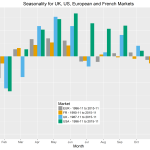
Inflation index values are decomposed into trend, seasonality and noise. Certain types of graph help identify seasonality. Graphs can be created simply and quickly in R. Simple graphs can be refined for stronger visual impact. Recently, I have been looking at inflation indices and studying their seasonality. The best way to see the overall trend and seasonality in this […]
Mechanics and Definitions of Bond Futures
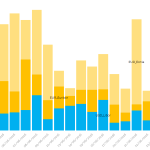
We focus on Bond Futures. They are a deep source of liquidity. We define the contracts and look at some of their common features. Analysing volumes across major bond futures is simple in CCPView. We find that around 60% of bond future notional is US related, with the remainder European. Invoice Spreads account for 3% of volumes in bond futures. What is […]
Mechanics and Definitions of Short Term Interest Rate Futures
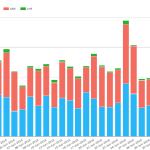
We focus on Short Term Interest Rate Futures contracts. In volatile markets, they are a deep source of liquidity. We define the contracts and look at some of their common features. Analysing volumes across all Short Term Interest Rate futures is simple in CCPView. We find that Short Sterling is more liquid than expected…. …and that FRA volumes relative to […]
CME Invoice Spread Volumes – updated
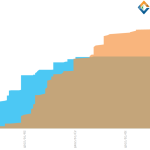
We update our analysis on the new CME Ultra 10 UST Future by looking at volumes in Invoice Spreads with matching dates to the futures contract. We find continued impressive volumes. About 6% of the risk-weighted volume in futures can be attributed to Swaps-related trades. The headline numbers Invoice Spreads versus the CME Ultra 10 UST Future are continuing to […]
Invoice Spread Trading in the New CME Ultra-10 Year Treasury Futures Contract
We take a look at Invoice Spreads with the help of two new features in the Clarus SDRView products. We closely examine swaps related to the new CME Ultra 10y UST Future. Swaps related trading looks to be a strong driver of volumes in the new contract so far. Looking at the maturity profile of the Spreadover market suggests […]
A Year of CFTC Fines

aka How to solve the CFTC budget crisis. Just before the 2015 holidays, the public received word that the CFTC had its 2016 budget set at $250 million dollars, representing no change from the previous year’s budget, and significantly less than the $322m that the Chairman proposed here, and that the President had proposed to Congress. […]
Cap and Floor Option Volumes
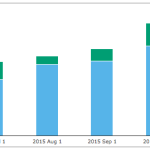
For a while now I have wanted to look into more detail at Caps and Floors, which are an important but little commented on product type. So it is seems appropriate as we near first the Federal Reserve rate rise since June 2006, to look at a product designed to set a Cap (or Floor) […]
Swap Spreads For Dummies – The LIBOR Joke
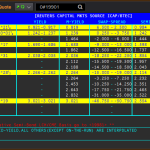
If you’re like me, you’ve read the news on negative swap spreads and tried to sift through the reasons behind it. On the surface, it seems such a basic premise that swap spreads need to be positive – surely there is an arbitrage out there. So I set out to understand it better by seeing […]
Quantitative Finance ‘GoodReads’

Two reading lists of books relevant to quantitative finance are provided using the GoodReads platform. Often I am asked to recommend good books to help a student, colleague or customer get a better grasp of quantitative finance. Instead of ad-hoc and incomplete lists, I thought it might be useful (especially for me) to have a […]
Principal Component Analysis of the Swap Curve: An Introduction
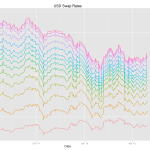
Principal Component Analysis (PCA) is a well-known statistical technique from multivariate analysis used in managing and explaining interest rate risk. Before applying the technique it can be useful to first inspect the swap curve over a period time and make qualitative observations. By inspection of the swap curve paths above we can see that; 1. […]